Secret Manet

Naked sandwich. When I was growing up I had a collection of Famous Paintings stamps- a gallery of 30 tiny masterpieces, fit for a Barbie house’ living room. I liked how under a magnifying glass the print on the stamps dissolved into pointillistic mess, also known as Benday Dots. One of the stamps depicted my favourite painting- Manet’s Luncheon on the Grass. It seemed like an obviously winning combo- the great outdoors, fresh air, food… The absurd presence of a naked woman only gave it gravitas and a confirmation that the world of grown ups didn’t make sense. Seemingly, it was specially true of 19c France. So when I heard recently The Royal Academy was mounting a Manet exhibition I, and my good friend Pat, obviously had to check it out.

"Luncheon on the Grass" (French &quo...

“Luncheon on the Grass” (French “Le déjeuner sur l’herbe”), originally titled Le Bain (The Bath) (Photo credit: Wikipedia)

Sandwich ethos. Have you noticed how, in terms of its ethos, the Royal Academy has sandwiched itself between Tate Britain and Tate Modern? Tate Britain puts on what used to be the cutting edge and controversial in its day. Tate Modern is keeping with its title and would not do anything less than eyebrow-raising. The Royal Academy is somewhere in between. Gross generalisation, I know. And still, a show of a grand master like Manet would needs to have popular items, as well as the more quirky works- exactly what they had at Portraying Life…

Art at night. I love going to the Royal Academy on late Friday night openings. In contrast to a Saturday during a high profile exhibition –respectful but determined bone-crashing efforts from the patrons to get up close and personal with the paintings- after 8pm on a Friday there’re very rarely ticket queues, no need to fight your way through the rooms full of tourists discussing where they’ll be having their dinner, and there’s no-one breathing down your neck when crowded around the star exhibit.

Also love the contrast between the chaotic Piccadilly with its shops (yes, I’m thinking of you Fortnums) and markets and endless traffic, and the contrast with the almost ritualistic hush of the Royal Academy. You can really just forget shopping for a moment. Its great!

Life and Love. So the exhibition title Portraying Life– doesn’t really mean anything- one hopes all art portrays life in some shape or form. Its like releasing an album Love in Song – give me a song which is not about love and I’ll give you the stars, because that does not exist. Here we had loosely selected works -some of which Manet didn’t want to exhibit and or weren’t commissioned. Thus alongside a portrait of Zola and one of the smaller versions of Le déjeuner sur l’herbe, there are those which had never been exhibited in his lifetime.

So, they were meant to reflect life around the artist more directly than the works he did exhibit and/or got paid for. Did I get this right, or could I say that Manet was true to life whether he was paid for his work or not?

May be by Life RA meant to focus on the intimate. It was still a great excuse to see live Manet- he’s so good at getting close and personal, his portraits are almost claustrophobic. How un-British of him to invade his sitter’s personal space! Compare and contrast with his contemporary John Singer Sargent (an American)- cool and stylish sitters, classy milieu.

I loved the photograph-like informality and composition in The Horsewoman or the many studies of his wife. In the crazy chaos of bohemian artistic Paris she must’ve looked like a pillar of stability.
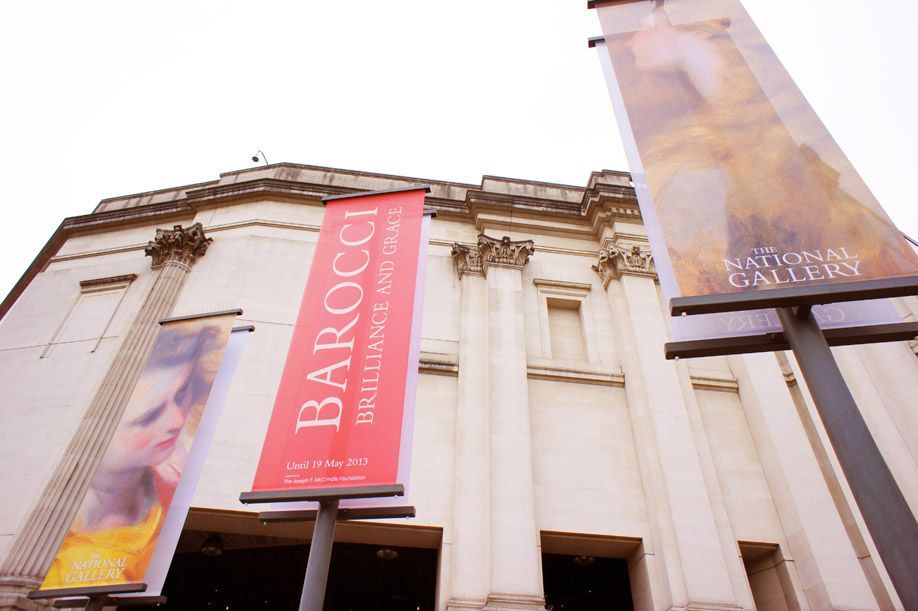
Barocci’s Baroque

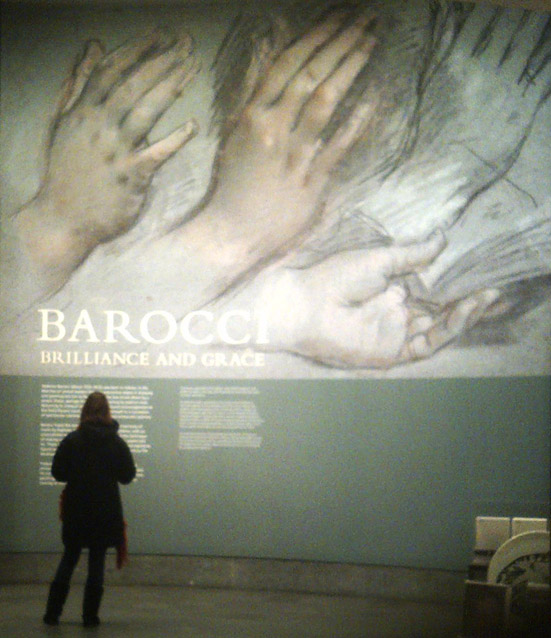
Federico Barocci- Brilliance and GraceThe National Gallery

Same day as my Lichtenstein visit I took myself to Barocci at the Sainsbury Wing of the National Gallery.

Duvet day at the galleries. It had been snowing that day– a truly mad mid-March. As we emerged out of the Leicester Square station, the icy Siberian winds slapped us on the face and the girl next to me screamed “f**k!”. I knew what she meant and regretted leaving those unstylish woolly gloves at home. Hiding in temperature-controlled gallery seemed my second best decision of the day. The first was not to go to work. And today is already August- it’s moisty and warm and rainy and makes London sort of feel like Kuala Lumpur but without the exotic smells of the Durian fruit and the drains.

Barocci small
Lonely
. So, Barocci is not Lichtenstein. Really?! But I’m not just talking about the difference of styles, themes, or everything else. It’s the visitors. I was the only one under 60 to be admiring the 16c master. I blame the timing – a Monday afternoon- though what happened to all the young and young-ish people, school parties and student types I saw pouring into the Tate Modern that same morning?!

Cos this was one of the most important colourists of Baroque, apparently. I have never heard of him before and I was in good company- the director of the National Gallery had never heard of him either until he did research for his doctorate!

It appears on his trip to Rome, Barocci was poisoned by rivals and then spent the rest of his life in poor health, churning out masterpieces in the tranquillity of his hometown of Urbino.

NG Sainsb

Naked male Maries. The exhibition notes didn’t explain why Barocci, who was so generous on the preliminary sketches and took great care in working out how the body worked under all that luxuriously flowing clothing, why he used male studio assistants as models- not only for his Christs and Josephs, but also for Maries and Elisabeths. In a series of sketches there you can see how a naked male model is gradually transformed into a naked Mary, and in the final drawing finally appears dressed. Did he not use female models on religious grounds?  You can see from his pastels he was a superb draftsman, so now thinking about it, its may be that anatomy, which he knew inside out, posed less of a problem for him than the actual composition?

The film the NG screened alongside the exhibition highlighted some obvious stuff but, also shows Barocci’s masterpieces in their natural habitats- en situ mostly in Urbino’s churches and chapels- n interesting (contrast?) to NG’s own hushed and almost spiritual tranquillity.

Federico Barocci - Aeneas' Flight from Troy - ...

Federico Barocci – Aeneas’ Flight from Troy – WGA01283 (Photo credit: Wikipedia)

Beware of the Greeks. One of the few non-religious works – Aeneas Fleeing Burning Troy– has this incredible energy, it could almost skip few generations of styles right into the Romanticism of Berlioz’s Les Troyens. The scene has Barocci’s trademarks of extremely detailed observation, and a super attention to the human emotion. As Aeneas carries his father with his 4 yo son under his feet, his wife behind him looks utterly exhausted. I suppose it’s all very Mannerism but so very humane at the same time, althrough Barocci’s work- whether it’s a domestic scene of the holy family with a cat, or the entombment of Christ- he draws out of you every single ounce of empathy. Though talking about the Holy Family- I did find the 12 year old-looking Mary and Joseph, approaching 80, somewhat wrong and a tad disturbing, especially as all members of the Holy Family looked so comfortable, happy and middle class.

Bromancing. You can imagine for someone who could make a St Joseph look homely, how good he’d been with strait portraiture. One of the very few at the exhibition, of his main patron Duke of Urbino, is probably the earliest fleshed out examples of bromance – both men were into books, music and, obviously, art, and had buckets of mutual admiration.

Virgin Mary and Black Square. My favourite though was the altarpiece Mary Visiting the House of Elisabeth. Apparently, when first displayed, the painting caused pandemonium and for weeks queues of pilgrims lined up to see it. And this is what Barocci wanted- to carry his own religious fervour into his art and take the viewer on ha similar emotional journey as when listening to a religious chant. The painting is a master class in handling space, flawlessly balanced composition, pallet and human emotion. And although I wasn’t prepared to convert there and then, I did hang around it for about 30 minutes. The last time I took so long with a painting, that I can recall, was Malevich’s Black Square. Both are simply perfect.

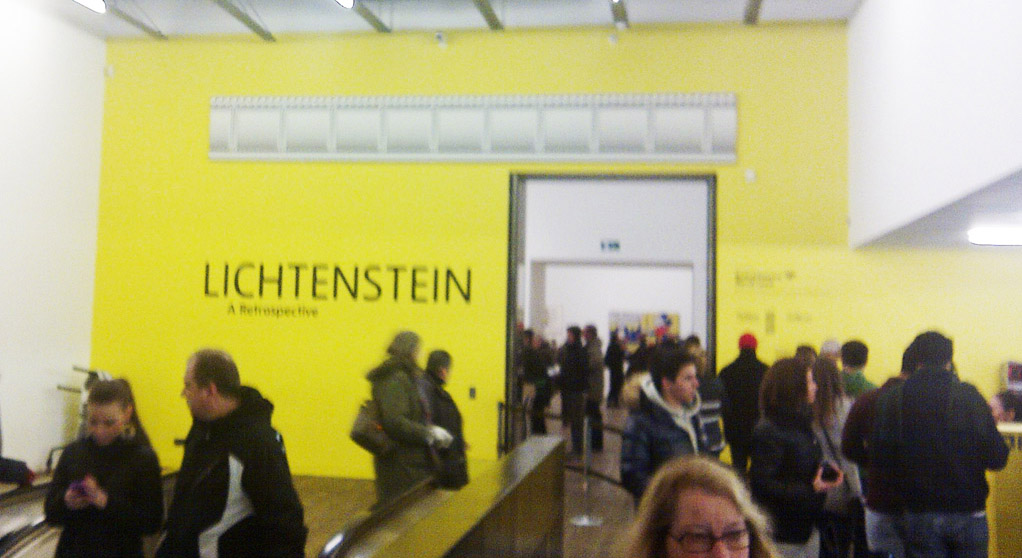
Lichtenstein dots

Lichtenstein @ Tate Modern, London.

Not Bothered
Am I the only one who’s not bothered about Lichtenstein? I know its not cool to expect an emotional connection with a modern painting, and that’s not what it’s about. But Lichtenstein does take the art ridiculing art concept to a completely new plane and his intellectual wonderings leave you stone cold. May be I’m completely missing the point here and it is his ability to objectify the existence of art that needs admiring? Lichtenstein’s rejection of make-belief reminds me of the dark period in Disney animation- sometime in the Nineties- where the fairytale magic was relegated to the background and the emotional sincerity replaced with wise-cracking donkeys and lamas.

Lichtenstein small
Brushstrokes
Taken within its own context, I liked how his Brushstrokes were about actual brushstrokes and nothing else- “Brushstrokes in paintings convey a sense of grand gesture, but in my hands, the brushstrokes become the depiction of a grand gesture”.

Benday
Similarly, in The Magnifying Glass, Lichtenstein has his iconic benday dots seen through the glass, erm, magnified, thus completely subverting his own style. In effect the painting could be called This is not a Magnifying Glass– so don’t suspend your belief yet.

Talk to me
I am always tempted to ask others what they think of art on display but wary of striking a conversation with overtly arty types they satirise in The Private Eye or with the gormless tourists having no opinion on what they’re seeing. Akin to striking a conversation on the tube, I’ll probably be seen as a socially challenged weirdo. Nevertheless, I promise next time I’ll make an effort- I’ll do the un-British thing and ask a random gallery visitor their opinion.

Raqib Shaw- Sick and beautiful

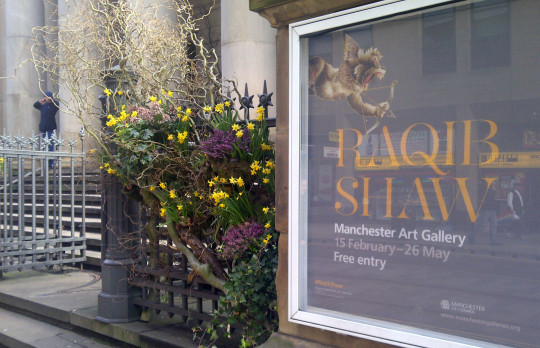
I said I live in London, right? But that doesn’t mean I’m London-centric, and I do believe there’s life outside the capital. A while ago I was visiting a pal in Manchester and came across the Manchester Art Gallery and my first Raqib Shaw exhibition.

img-20130316-00629

Even before you got to the gallery you could guess it wasn’t going to be a regular gig. Shaw wasn’t confined to the second floor but spilled out onto the street. He covered the iron fencing around the gallery in shrubs and slim tree trunks with nests of daffodil bulbs cocooned in moss. It all looked quite spring-y once the daffodils bloomed!

The floral attack continued inside the main atrium where placid plants hang off the walls and hand railings, like a mini Hanging Garden of Babylon. The centrepiece was the statue in a shrine of plants and flowers on the staircase landing. A swan was raping a half-man/half-bat and, in a moment of rapture, ripping out the heart of his sex companion. Like most people there I self-consciously stuck my head right into the shrine where the swan action was occurring to see if it made any more sense. It didn’t.

This flowers/sex/death kicked off on a grand scale in the main exhibition hall. Exoticism, beauty, violence and animals seemed closely interwoven in all of Shaw’s work, no less so than in another sculpture ensemble capturing a crayfish fornicating with a man-eagle. Graphically violent than the swan but as realistic, in my mind the brutal crescendo was just round the corner. Or was it just me imagining the worst?

There was the same attention to detail evident in all Shaw’s work- the toes on the human foot were so life-like, you’d think its spasms could restart any moment. Realism and focus on the small underline the brutality of Shaw’s world. He blurs the line between human, animal, beautiful and sick and manipulates your own imagination to picture the unthinkable.

Shaw’s work (can be loosely described as paintings) made the rest of the sizable exhibition. They all are just as busy with detailed, miniature-like attention to small and inlaid with rhinestones.

It a shame his chosen media doesn’t photograph well and the illustrations in catalogues in the gallery shop gave only faint impressions of the originals.

Have to admit- this obsession with the symbolism, narrative and the detail, that would give the Pre-Raphaelites a run for their money, makes his work look very busy and after a few pictures you reach your limit of how much you can take in. As exciting as it is to see so many of Shaw’s works in the same space, it would be interesting to see his work next to what actually influenced him, like other artists or his Indian roots. Can’t remember this being mentioned anywhere else, but the almost OCD-like preoccupation with the small reminds of Dadd’s The Fairy Feller’s Master-Stroke.

In his video Shaw points out the painters who influenced him, or details of which paintings he incorporated in his own work. But he didn’t say how they influenced him. I suppose no artist can completely explain comprehensively his work, because that’s not what visual art is about. In fact, the less you talk about the work the better.