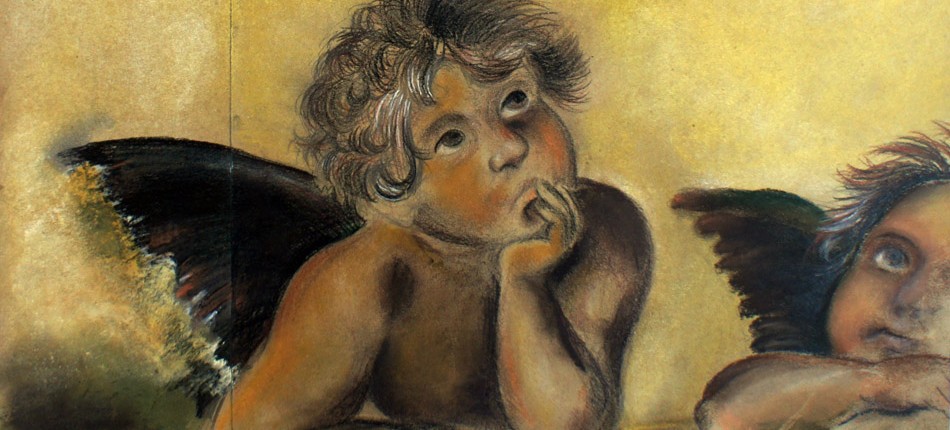
Federico Barocci- Brilliance and Grace @ The National Gallery
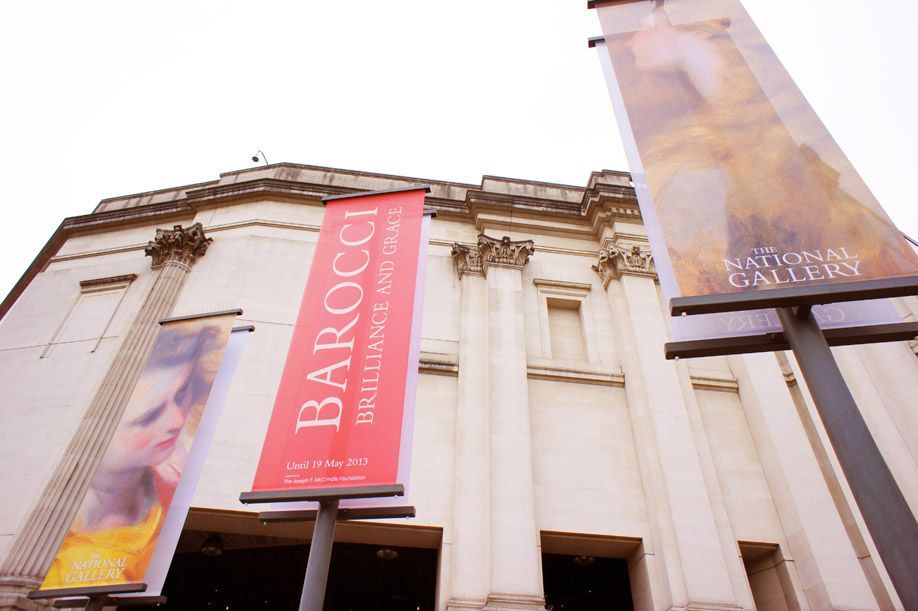
Same day as my Lichtenstein visit I took myself to Barocci at the Sainsbury Wing of the National Gallery.
Duvet day at the galleries. It had been snowing that day– a truly mad mid-March. As we emerged out of the Leicester Square station, the icy Siberian winds slapped us on the face and the girl next to me screamed “f**k!”. I knew what she meant and regretted leaving those unstylish woolly gloves at home. Hiding in temperature-controlled gallery seemed my second best decision of the day. The first was not to go to work. And today is already August- it’s moisty and warm and rainy and makes London sort of feel like Kuala Lumpur but without the exotic smells of the Durian fruit and the drains.
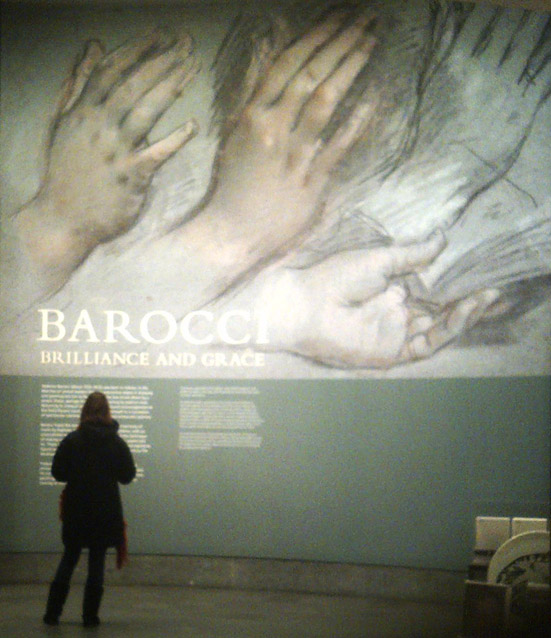
Lonely. So, Barocci is not Lichtenstein. Really?! But I’m not just talking about the difference of styles, themes, or everything else. It’s the visitors. I was the only one under 60 to be admiring the 16c master. I blame the timing – a Monday afternoon- though what happened to all the young and young-ish people, school parties and student types I saw pouring into the Tate Modern that same morning?!
Cos this was one of the most important colourists of Baroque, apparently. I have never heard of him before and I was in good company- the director of the National Gallery had never heard of him either until he did research for his doctorate!
It appears on his trip to Rome, Barocci was poisoned by rivals and then spent the rest of his life in poor health, churning out masterpieces in the tranquillity of his hometown of Urbino.
Naked male Maries. The exhibition notes didn’t explain why Barocci, who was so generous on the preliminary sketches and took great care in working out how the body worked under all that luxuriously flowing clothing, why he used male studio assistants as models- not only for his Christs and Josephs, but also for Maries and Elisabeths. In a series of sketches there you can see how a naked male model is gradually transformed into a naked Mary, and in the final drawing finally appears dressed. Did he not use female models on religious grounds? You can see from his pastels he was a superb draftsman, so now thinking about it, its may be that anatomy, which he knew inside out, posed less of a problem for him than the actual composition?
The film the NG screened alongside the exhibition highlighted some obvious stuff but, also shows Barocci’s masterpieces in their natural habitats- en situ mostly in Urbino’s churches and chapels- n interesting (contrast?) to NG’s own hushed and almost spiritual tranquillity.

Federico Barocci – Aeneas’ Flight from Troy – WGA01283 (Photo credit: Wikipedia)
Beware of the Greeks. One of the few non-religious works – Aeneas Fleeing Burning Troy– has this incredible energy, it could almost skip few generations of styles right into the Romanticism of Berlioz’s Les Troyens. The scene has Barocci’s trademarks of extremely detailed observation, and a super attention to the human emotion. As Aeneas carries his father with his 4 yo son under his feet, his wife behind him looks utterly exhausted. I suppose it’s all very Mannerism but so very humane at the same time, althrough Barocci’s work- whether it’s a domestic scene of the holy family with a cat, or the entombment of Christ- he draws out of you every single ounce of empathy. Though talking about the Holy Family- I did find the 12 year old-looking Mary and Joseph, approaching 80, somewhat wrong and a tad disturbing, especially as all members of the Holy Family looked so comfortable, happy and middle class.
Bromancing. You can imagine for someone who could make a St Joseph look homely, how good he’d been with strait portraiture. One of the very few at the exhibition, of his main patron Duke of Urbino, is probably the earliest fleshed out examples of bromance – both men were into books, music and, obviously, art, and had buckets of mutual admiration.
Virgin Mary and Black Square. My favourite though was the altarpiece Mary Visiting the House of Elisabeth. Apparently, when first displayed, the painting caused pandemonium and for weeks queues of pilgrims lined up to see it. And this is what Barocci wanted- to carry his own religious fervour into his art and take the viewer on ha similar emotional journey as when listening to a religious chant. The painting is a master class in handling space, flawlessly balanced composition, pallet and human emotion. And although I wasn’t prepared to convert there and then, I did hang around it for about 30 minutes. The last time I took so long with a painting, that I can recall, was Malevich’s Black Square. Both are simply perfect.
 Max and Art