Saints alive alive oh…

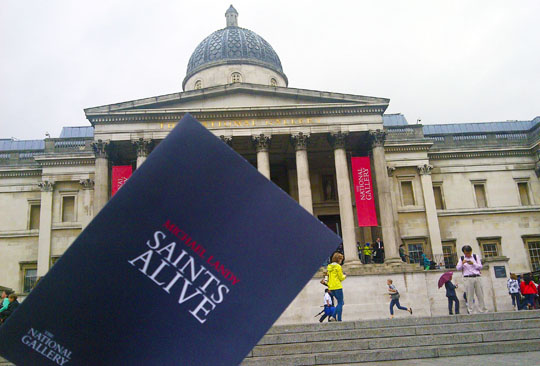
Michael Landy- Saints Alive @ The National Gallery

Little Max and God. The first time I heard about God I was five years old. It was early morning and my great nanny Lisa and I were walking to a nearby field to look for lost sheep (I promise this is not Christ/shepherd analogy). I quizzed Lisa why sheep want to run away and she replied- “Ask our Holy Father in heavens, He will always hear you out”. Having been born in Communist Russia, I never heard such an advice before and got immensely intrigued. Later that day, as Lisa was dosing on the grass near the found sheep, I cocked my head up and asked the wispy clouds in the glorious blue sky, what I thought was, a series of pretty searching questions. There came no answer, but from looking at the sky for a long time I felt like I was falling into a bottomless azure pit. That was the beginning of my vertigo and the end to my god-searching.
Saints alive

Violence into sainthood. Saints Alive at The National Gallery is also a kind of god-searching, or rather searching to understand the mechanics of faith- which to some comes so easily, to others- less so. So this isn’t Barocci’s saints I wrote about in an earlier blog. Michael Landy’s latest installation definitely doesn’t dwell on their divine destiny. Instead he focuses on the juicy and graphic violence, you know the kind that gets you canonised. There’s the stigmatisation of St Francis and St Gerome’s flagellation; here’s St Catherine being broken on a wheel; there’s St Thomas poking Christ’s wounds; over here St Appolonia pulling out her own teeth, one by one…

As Landy’s a self-proclaimed philistine in art history, the whole point of the exhibition, it seemed, was to offer a refreshing perspective on art. The perspective is certainly refreshing and startling, and even freaky. It also manages, predictably, to rattle a few cages- e.g. Brian Sewell, who, as per his contributions in ES, doesn’t seem to like much that comes out of TNG these days.

You make them hurt them. Notwithstanding Mr Sewell’s efforts, at the time when I went there on a Saturday morning, it had a healthy queue at the entrance. The larger-than-life automaton of St Apollonia that you could see through the double doors was a good indicator of what was to be expected inside- at a press of a floor pedal the statue motioned to pull its own teeth with a pair of oversized pliers and in the process chipped away at its angelic face. The rest of the fibreglass-plaster-and-paint kinetic statues re-enacted self-harm at my command on a biblical scale.

Even though by the time of my own visit two of the statues broke down, it didn’t diminish the effect of the rest of the exhibits. In the almost religious silence of the National Gallery the sudden violent animation of St Thomas’ disembodied hand repeatedly prodding Christ’s torso made for creepy experience, which in a weird way brought home the violence and pain of Jesus’ martyrdom.

In art symbolism is all. Here it turns round and hits you in the face, almost. I suppose the next step would be to extend the interaction with the display by actually flagellating, stigmatising and breaking us the visitors on Catherine’s wheel. Though some people might actually enjoy that…

If there is a message, it is subversive. Whilst inviting you to turn St Catherine’s Wheel in the re-enactment of how she was tortured for her Christian believes, you can read on the same wheel her life in a neat, yet seditious, resume. In homage to St Francis’ refusal of earthly delights, his statue becomes a lucky dip arcade machine, bestowing on visitors free t-shirts. The automaton next door hits itself in the face with a Crucifix- after you deposit money in its coin slot. There doesn’t seem to be much of an outcry from the religious contingent. I’m guessing this is mainly because most people are not familiar with the imagery altogether or just don’t care?

In my earlier post I mentioned Barocci, who spent his life contemplating and depicting religion, which he was so obsessed with. For him The Holy Family was as real as his own parents, his painful wasting disease- the first step towards martyrdom. And so his paintings inspired in others an even greater devotion. Today, when the Sunday School is less popular that even a few decades ago, I’m guessing, most gallery visitors can’t distinguish between Mary Magdalene and Virgin Mary. It might well have to be something as interactive and unsubtle as an automaton plunging a cleaver into its own temple to bring the myths of these saints from relative obscurity and to the forefront of our attention.
Barocci’s Baroque

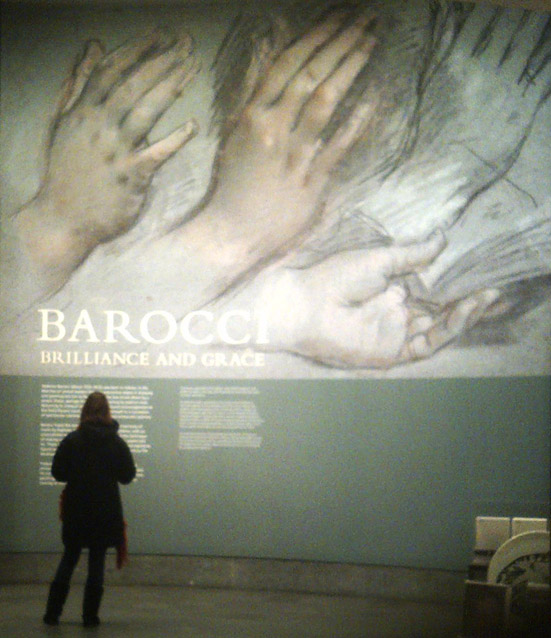
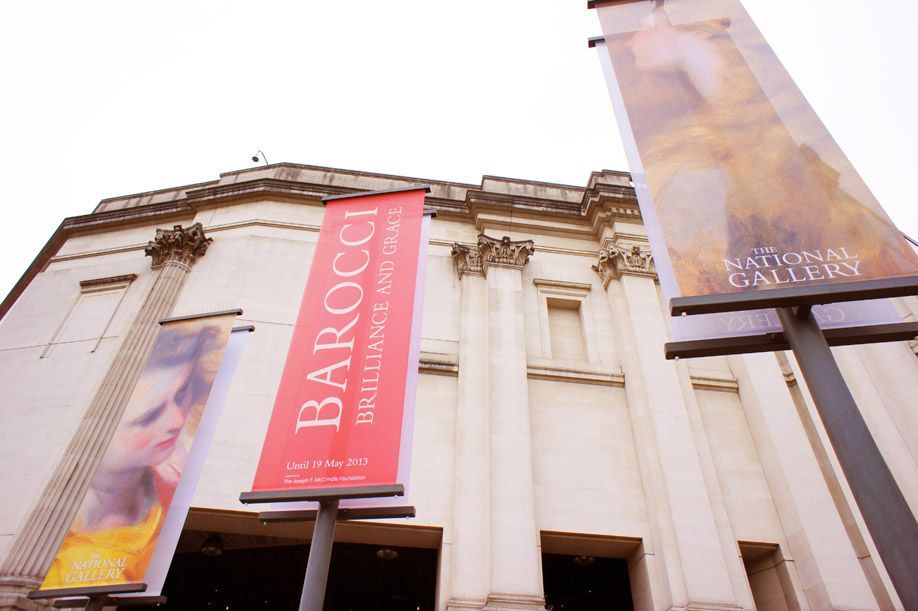
Federico Barocci- Brilliance and GraceThe National Gallery

Same day as my Lichtenstein visit I took myself to Barocci at the Sainsbury Wing of the National Gallery.

Duvet day at the galleries. It had been snowing that day– a truly mad mid-March. As we emerged out of the Leicester Square station, the icy Siberian winds slapped us on the face and the girl next to me screamed “f**k!”. I knew what she meant and regretted leaving those unstylish woolly gloves at home. Hiding in temperature-controlled gallery seemed my second best decision of the day. The first was not to go to work. And today is already August- it’s moisty and warm and rainy and makes London sort of feel like Kuala Lumpur but without the exotic smells of the Durian fruit and the drains.

Barocci small
Lonely
. So, Barocci is not Lichtenstein. Really?! But I’m not just talking about the difference of styles, themes, or everything else. It’s the visitors. I was the only one under 60 to be admiring the 16c master. I blame the timing – a Monday afternoon- though what happened to all the young and young-ish people, school parties and student types I saw pouring into the Tate Modern that same morning?!

Cos this was one of the most important colourists of Baroque, apparently. I have never heard of him before and I was in good company- the director of the National Gallery had never heard of him either until he did research for his doctorate!

It appears on his trip to Rome, Barocci was poisoned by rivals and then spent the rest of his life in poor health, churning out masterpieces in the tranquillity of his hometown of Urbino.

NG Sainsb

Naked male Maries. The exhibition notes didn’t explain why Barocci, who was so generous on the preliminary sketches and took great care in working out how the body worked under all that luxuriously flowing clothing, why he used male studio assistants as models- not only for his Christs and Josephs, but also for Maries and Elisabeths. In a series of sketches there you can see how a naked male model is gradually transformed into a naked Mary, and in the final drawing finally appears dressed. Did he not use female models on religious grounds?  You can see from his pastels he was a superb draftsman, so now thinking about it, its may be that anatomy, which he knew inside out, posed less of a problem for him than the actual composition?

The film the NG screened alongside the exhibition highlighted some obvious stuff but, also shows Barocci’s masterpieces in their natural habitats- en situ mostly in Urbino’s churches and chapels- n interesting (contrast?) to NG’s own hushed and almost spiritual tranquillity.

Federico Barocci - Aeneas' Flight from Troy - ...

Federico Barocci – Aeneas’ Flight from Troy – WGA01283 (Photo credit: Wikipedia)

Beware of the Greeks. One of the few non-religious works – Aeneas Fleeing Burning Troy– has this incredible energy, it could almost skip few generations of styles right into the Romanticism of Berlioz’s Les Troyens. The scene has Barocci’s trademarks of extremely detailed observation, and a super attention to the human emotion. As Aeneas carries his father with his 4 yo son under his feet, his wife behind him looks utterly exhausted. I suppose it’s all very Mannerism but so very humane at the same time, althrough Barocci’s work- whether it’s a domestic scene of the holy family with a cat, or the entombment of Christ- he draws out of you every single ounce of empathy. Though talking about the Holy Family- I did find the 12 year old-looking Mary and Joseph, approaching 80, somewhat wrong and a tad disturbing, especially as all members of the Holy Family looked so comfortable, happy and middle class.

Bromancing. You can imagine for someone who could make a St Joseph look homely, how good he’d been with strait portraiture. One of the very few at the exhibition, of his main patron Duke of Urbino, is probably the earliest fleshed out examples of bromance – both men were into books, music and, obviously, art, and had buckets of mutual admiration.

Virgin Mary and Black Square. My favourite though was the altarpiece Mary Visiting the House of Elisabeth. Apparently, when first displayed, the painting caused pandemonium and for weeks queues of pilgrims lined up to see it. And this is what Barocci wanted- to carry his own religious fervour into his art and take the viewer on ha similar emotional journey as when listening to a religious chant. The painting is a master class in handling space, flawlessly balanced composition, pallet and human emotion. And although I wasn’t prepared to convert there and then, I did hang around it for about 30 minutes. The last time I took so long with a painting, that I can recall, was Malevich’s Black Square. Both are simply perfect.